
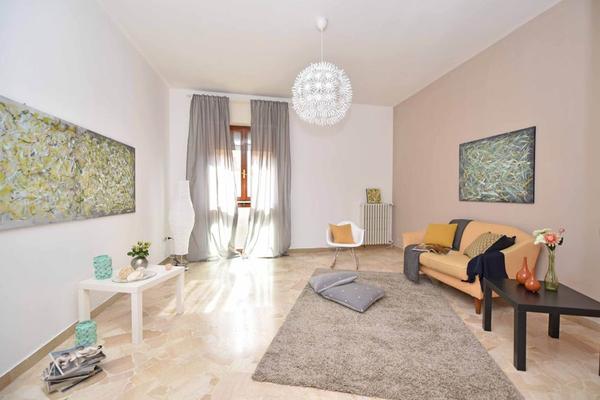
A big blank wall can make a living room feel unfinished even when the furniture, lighting, and colour scheme are working well. The usual problem is not style but scale. Art that looks substantial in a hallway can disappear above a long sofa. Large wall art for living room spaces works best when it has enough visual weight to balance the furniture without overwhelming the room.
The easiest way to get that balance is to think in proportions rather than shopping by instinct. Measure first, use the sofa or console as your visual anchor, and test the dimensions before committing to a piece.
Start With the Furniture, Not the Entire Wall
When artwork hangs above a sofa, sideboard, or console, the furniture usually matters more than the full width of the wall. A useful starting point is art that measures roughly two-thirds to three-quarters of the width of the furniture below it. This is a guideline rather than a fixed rule, but it helps the artwork and furniture read as one connected composition.
For example, imagine a sofa that is 240 cm wide. Artwork around 160 to 180 cm wide will often look more balanced than a 70 cm print centred above it. If one piece at that size is impractical, two coordinated panels can create a similar overall footprint.
Use Simple Sizing Math Before You Shop
Measure the usable wall area, excluding windows, tall lamps, shelving, door openings, and architectural features that interrupt the space. Then measure the furniture beneath the intended art. Those measurements will tell you whether a single oversized canvas art piece, a diptych, or a small group of coordinated works is likely to suit the room.
Do not assume high ceilings mean the art should be hung unusually high. Above a sofa or console, a gap of roughly 15 to 25 cm between the furniture and the bottom edge of the artwork is a useful starting range. Adjust it for unusually high-backed furniture, deep frames, or strong architectural lines.
Choose a Format That Matches the Space
The shape of the empty area often suggests the right type of statement wall art. A long wall above a three-seat sofa or sectional usually suits a wide landscape-format piece, while a taller, narrower area beside a fireplace may work better with vertical artwork. Matching the art’s proportions to the available space helps it feel intentional.
One Large Statement Piece
A single oversized artwork creates the cleanest focal point. It is particularly effective in rooms where too many smaller objects would add visual noise. Canvas can work well at large sizes because it provides plenty of visual area without the heavier appearance of multiple thick frames.
Two or Three Coordinated Panels
A diptych or triptych can be easier to transport and hang than one enormous piece. Keep the gaps fairly narrow so the panels read as a unified composition. This is one of the more practical big wall decor ideas for apartments or homes where getting a giant frame through doors and stairways would be difficult.
Textiles and Lightweight Alternatives
Large-scale wall decor does not have to be a traditional print. Woven hangings, stretched fabric, quilts, and decorative panels can cover a generous area while adding texture. They are especially useful in rooms dominated by glass, polished surfaces, or smooth upholstery.
Use Colour to Connect the Art to the Room
The artwork does not need to match the sofa or rug exactly. Instead, repeat one or two existing colours and allow the piece to introduce a related accent. In a neutral room with cream upholstery, warm wood, and black details, art containing olive, rust, muted blue, or burgundy can add depth without feeling disconnected.
If the room already contains several strong colours and patterns, simpler artwork may work better. Negative space or a restrained palette can give the eye somewhere to rest. The aim is visual connection, not perfect colour matching.
Fill a Huge Wall Without a Huge Budget
Truly oversized original artwork can be expensive, but scale does not require a luxury purchase. Large-format prints, stretched fabric, vintage textiles, and coordinated panels can provide generous coverage for less. A simple canvas can also gain more presence with a floating frame.
Another option is to use two or three generously sized frames rather than many small ones. If you prefer a gallery arrangement, treat the entire group as one large rectangle and make sure its total width is substantial enough for the furniture below.
Mock Up the Size Before Buying
One of the best ways to avoid an expensive mistake is to mark the proposed outer dimensions on the wall with painter’s tape. Then view the outline from the main seating position, the doorway, and across the room. Dimensions that sound enormous online can look surprisingly appropriate above a genuinely long sofa.
For a clearer test, tape sheets of paper or cardboard together to create a full-size template. This makes it easier to judge clearance around lamps, shelves, windows, and the sofa. It can also show whether the art should be centred over the furniture rather than the entire wall.
What If the Art You Love Is Too Small?
You do not always need to replace it. A wider frame, generous mat, companion artwork, or carefully positioned furniture can increase its visual presence. A picture light may also give a smaller piece more importance after dark. The key is to build a larger visual composition around it instead of leaving a small frame isolated on a huge wall.
Related topics such as living room focal point ideas, gallery wall spacing, and living room colour schemes are useful next steps when deciding how the artwork should relate to the rest of the room.
Frequently Asked Questions
What size wall art should go above a sofa?
A good starting point is artwork, or a grouped composition, measuring roughly two-thirds to three-quarters of the sofa’s width. Adjust the proportion for side tables, lamps, frame style, and the open wall around it.
Can wall art be wider than the sofa?
Yes, but it can be harder to balance. Art that extends far beyond the sofa may make the furniture look undersized unless side tables, lamps, or other elements create a wider visual base underneath it.
Is one large artwork better than several smaller pieces?
Neither is automatically better. One large piece creates a calmer focal point, while two or three coordinated pieces offer more flexibility and may be easier to transport. What matters most is the total scale of the composition.
How can I fill a large wall without making it look cluttered?
Use fewer elements at a larger scale. One oversized piece, a restrained diptych, or a large textile usually looks calmer than many unrelated small decorations spread across the same wall.
Give the Wall Enough Visual Weight
Filling a big blank wall is mainly an exercise in proportion. Measure the furniture, calculate a sensible artwork width, match the format to the shape of the space, and test the size before buying. Once the scale is right, even a simple piece can make the living room feel finished, balanced, and intentional.