
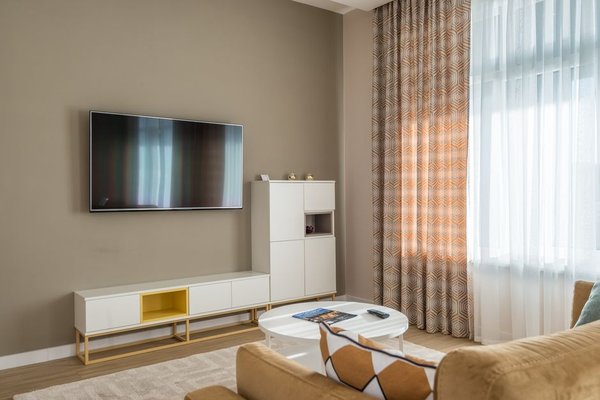
Living room curtains do more than soften a window. They influence how much daylight reaches the sofa, what neighbours can see after dark, and whether the window looks properly scaled to the room. The best living room curtain ideas begin with those three jobs rather than a fabric colour.
Before shopping, watch the room in the morning, late afternoon and after switching on the lamps. A fabric that looks private at noon may reveal silhouettes at night. A curtain that looks lovely when closed may block too much light when open. Those observations make choosing a treatment easier.
Start With the Light and Privacy You Need
Choose sheers for softened daylight
Sheer linen-look or voile panels diffuse sunlight while keeping a room bright. They suit windows overlooking a garden or quiet street. From outside, however, people may see into a lit room at night. For evening privacy, pair sheers with lined curtains or a separate shade.
Use lined curtains where glare is a problem
A closely woven, lined fabric offers better privacy and can reduce television glare. Blackout lining blocks substantially more light than ordinary lining, although gaps around the top and sides can still let light through. It makes sense for media-focused rooms but is unnecessary everywhere.
For west-facing windows, consider the afternoon sun’s angle rather than buying the darkest fabric automatically. A light-filtering shade behind decorative drapery controls glare while curtains stay open. This is one of the most flexible window treatment ideas for living room spaces serving several purposes.
Make Windows Look Taller and Wider
Hang the rod above the frame
Curtain placement changes how a room feels. Installing a rod several inches above the frame, where space permits, draws the eye upward. Where there is little wall between the window and ceiling, a ceiling-mounted track can be neater.
Extend the rod beyond both sides so the open panels gather against the wall instead of covering the glass. Around 6 to 12 inches on each side is a useful starting point, adjusted for wall space, fabric thickness, furniture and corners. Uncovering the glass helps daylight reach farther into the room.
Let the hem meet the floor neatly
Floor-length curtains create a more continuous line than panels ending awkwardly below the sill. For a tailored finish, let the hem sit just above the floor or lightly touch it. Puddled fabric can look romantic but collects dust and complicates cleaning.
If a radiator, heater or vent sits below the window, check clearance and airflow before hanging long curtains. A shade or shorter treatment may be safer and more practical than fabric covering a heat source.
Get Curtain Width Right Before Choosing a Pattern
Insufficient width is a common problem with ready-made panels. Narrow curtains may technically close but stretch nearly flat across the window, leaving an underdressed look and possible privacy gaps.
As a starting guide, make the combined flat width of the panels roughly 1.5 to 2 times the rod or track width, depending on the fabric and desired fullness. Lightweight sheers may need more gathering; thick fabrics often need less. Check whether retailers list width per panel or per pair.
For example, with an 80-inch rod, a total panel width of about 120 to 160 inches will usually look fuller than two 52-inch panels. Measure the installed rod, not just the glass, and check how the heading gathers. For extra guidance, see [how to measure windows for curtains].
Pick Fabrics That Suit Everyday Life
Fabric influences light, privacy and the way folds hang. Linen and linen blends feel relaxed but natural linen can wrinkle. Cotton blends are versatile, while velvet and heavier fabrics add visual weight. Check care instructions and whether lining is included.
Among living room drapery ideas, texture can be more useful than a dramatic print. A subtle woven surface adds depth without competing with rugs or artwork. In a room with patterned upholstery, a plain curtain in one of the existing colours creates continuity.
Take samples home and hold them at the window by day and under lamps at night. Pale fabric can become surprisingly translucent when backlit. If choosing between tones, [living room colour combinations] can help coordinate curtains with the walls.
Choose Hardware Based on How Curtains Move
Ripple-fold curtains on a track create even waves and move smoothly when properly installed. Pinch pleats offer a tailored look. Rod pockets may suit mostly stationary panels but can be awkward to slide. Rings or gliders are helpful for curtains opened every day.
At a sliding patio door, provide enough track for curtains to stack away from the opening. Consider door swing and furniture before choosing one-way or centre-opening panels. A bay window may need a bent track or separate rods; measure corners carefully so brackets do not prevent closure.
Layer Treatments When One Fabric Cannot Do Everything
Imagine a street-facing living room used for video calls by day and films at night. Sheers reduce exposure in daylight; lined outer curtains provide privacy with lamps on. On bright afternoons, an adjustable shade can reduce screen glare without darkening the whole room.
Not every window needs three layers. In a small room, a roller or Roman shade with stationary side panels offers control and softness without crowding the wall. Where natural light is limited, use a compact stack-back and a pale treatment. [Layered living room lighting] can help balance daylight with lamps after sunset.
Before ordering, try operating the treatment in your mind: Will panels clear the sofa arm? Do they catch on brackets? Can you clean them easily? Do pets reach the hem? Practical answers matter just as much as the finished photograph.
Frequently Asked Questions
What curtains make a small living room look bigger?
Mount curtains above the frame where possible, extend the rod beyond the glass and choose floor-length panels. Fabric close to the wall colour creates a continuous look, while adequate width gives the folds substance.
Are sheer curtains enough for living room privacy?
Sheers can soften views into a room during daylight, but they are not dependable after dark with interior lights on. Add opaque curtains or a shade for windows facing neighbours or walkways.
Should living room curtains touch the floor?
For most everyday rooms, curtains that lightly touch the floor or finish just above it look intentional and are easier to maintain than puddled hems. Measure after fitting the hardware for an accurate length.
Must every living room window have matching curtains?
Matching fabrics and hanging heights create cohesion, especially on the same wall. Different windows can use related treatments when their needs differ, such as decorative panels on one window and an added shade on a sunnier one.
Bring Light, Privacy and Proportion Together
Successful living room curtain ideas are rarely about finding the boldest fabric. Begin with daylight and privacy, position hardware to balance the window, and allow enough width for attractive folds. Then choose a texture and heading that suit daily use. The result will feel considered from morning through evening, not just when the curtains are perfectly arranged.