
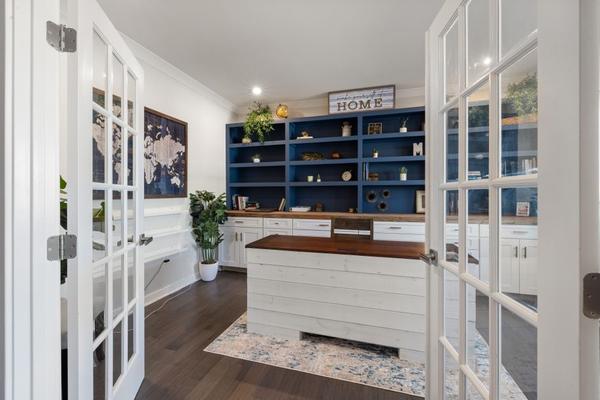
A home office has to do two jobs: support focused work and look composed when the camera turns on. The best home office decor ideas solve both at once. Instead of styling every visible surface, think about what your webcam actually sees, how light falls across your face, and which objects create a calm frame without competing for attention.
Open your usual meeting app, switch on the preview, and look at the image as if it were a photograph. Notice distracting cords, harsh shadows, bright windows, and objects that appear to “grow” out of your head. Small changes often make a bigger difference than a full makeover.
Design the Room From the Camera Frame Out
Set your webcam near eye level and sit where you normally work. A camera that is too low can make the ceiling dominate the frame, while one that is too high may reveal more desk clutter than you intended. Eye-level positioning creates a more natural presence and makes the background easier to compose.
Next, decide what should appear behind you. A simple wall, one section of shelving, a narrow console, or a small art arrangement can all work. Keep the area directly behind your head relatively quiet, then place more visual interest slightly off-center. This gives zoom background decor personality without making it look staged.
Try a Simple Three-Zone Test
Divide your camera view into left, center, and right. Let the center stay calmer, then balance the outer areas with two different elements, such as framed art on one side and a plant or lamp on the other. The objects do not need to match; they only need enough visual weight to feel balanced.
Make Lighting Part of the Decor
Good lighting improves both the workspace and the video image. Front or slightly side-front light is usually more useful than a bright source directly behind you. If your desk is near a window, arrange the monitor and lamps so light does not bounce into the screen. Diffused light and matte finishes can also reduce glare.
A table lamp with a fabric shade can soften the room while becoming part of the background composition. If the ceiling light feels harsh, layer it with a desk or floor lamp rather than relying on one bright source. Video apps can brighten a dim image, but room lighting looks more natural.
Choose Desk Decor That Earns Its Space
Useful desk decor ideas begin with restraint. Keep the things you touch every day within reach, then limit purely decorative pieces to one or two. A ceramic pencil cup, a small plant, a wood tray, or a framed photo can add personality without shrinking the usable work surface.
Hide the visual noise that cameras exaggerate. Route charging cables behind the desk, use a tray for small accessories, and give notebooks a consistent home. If the desk appears in the frame, organizers with similar finishes will look more intentional than a mix of unrelated containers.
For example, imagine your shelves look polished but the bottom of the frame shows three chargers, a tissue box, and a pile of mail. Moving those items into a shallow drawer or lidded box will improve the shot immediately, often more than adding another piece of wall art.
Style Shelves for Depth, Not Density
Office shelf styling works best when there is breathing room between objects. On camera, tightly packed shelves can turn into visual static. Leave some sections partly empty, combine books in short groups, and vary heights with one plant, vase, or framed object.
Think in layers. Place a larger piece toward the back and a smaller object slightly forward, while keeping negative space around both. Books can be stacked horizontally to support a small decorative item, while vertical groups add height. If you collect books or objects, group similar pieces together instead of scattering single items across every shelf.
Use Color Without Adding Clutter
Paint and textiles can shape the room without taking up workspace. Soft neutrals and muted shades such as warm off-white, green, blue, clay, or taupe can create depth while remaining easy to live with. Matte or low-sheen finishes are useful where reflected light might become distracting.
Repeat one accent color two or three times within the visible frame. A blue notebook, a detail in a print, and a cushion in a related tone can connect the scene. Keep the repetition subtle; matching everything exactly can make the office feel more like a set than a real room.
Add Personality Without Distracting From You
A good home office should still reveal something about the person using it. A travel print, a favorite design book, a handmade object, or a plant feels more authentic than generic filler. Choose pieces that are large enough to read at webcam scale. Tiny ornaments can disappear visually while still making shelves feel busy.
If a frame sits directly behind your head, move it slightly to one side or raise it enough to remain visually separate. For a gallery wall, test the arrangement through the webcam before making every placement permanent.
Keep the Background Flexible
Not every call needs the same level of formality. Put paperwork and busy accessories in closed storage, keep one tidy wall or shelf arrangement available, and use movable lamps or plants to adjust the frame. If you sometimes use a virtual background, even lighting on you and the area behind you can help the software separate foreground from background more cleanly.
Related guides on small home office layout ideas, office lighting, and work-from-home desk organization fit naturally into this setup because they improve the room itself rather than simply decorating the camera view.
Frequently Asked Questions
What should I put behind my desk for video calls?
Try one larger visual element plus one smaller accent, such as framed art with a plant, a tidy shelf with a few books, or a console with a lamp. Keep the space directly behind your head simpler so your face remains the focal point.
How can I improve my home office background without spending much?
Remove clutter from the camera frame, hide cables, raise the camera to eye level, and improve front lighting first. Rearranging objects you already own can have more impact than buying new decor.
What colors work well for a home office background?
Soft neutrals and muted colors are versatile choices. Pick a shade that gives some contrast with your furniture and typical clothing, and consider matte finishes if glare is a problem.
How much should I display on office shelves?
There is no fixed number, but shelves usually look calmer when some open space remains visible. Group books and objects into a few intentional clusters, then check the result on camera because shelves can appear busier on screen than they do in person.
Create a Room That Works On and Off Camera
The strongest home office decor ideas are not about turning your workspace into a permanent video set. Set the camera position first, control glare and lighting, simplify what appears behind you, and then add a few meaningful details. When the room looks calm through the lens and still feels comfortable after the meeting ends, the decor is doing its job.